Monday, July 18, 2011

Mercer Mayer: The Newly Re-Discovered 70s Penthouse Magazine Illustrations! A Book 'em Bob exclusive!

As  – what I assumed to be – a gag gift last year, I received a group of Penthouse: The International Magazine for Men magazines most of which were released during the year of my birth, 1975.  I flipped through them and I put them away for awhile.  While discussing some authors online, it was mentioned that some of my favorite writers had works in these magazines and that was why they were given to me (WilliamKotzwinkle, Nick Tosches, J. G. Ballard, Cameron Crowe, Peter Benchley, and more).  So, they came out of storage, and I started reading them (really, for the articles, ha ha).

While reading, I discovered that I enjoyed the humor of a semi-regular columnist named Henry Morgan ("The Original Bad Boy of Broadcasting").  Henry Morgan, who was born in March of 1915 and died in May of 1994, was a humorist.  He was an actor, a comedian, a game show host, a radio personality, and a writer.  He wrote about 50 or more humor columns for Penthouse magazine from 1970 to 1976.  I do not have all of these issues (not even close, ha ha), but I went through the ones that I have in order to read these articles and most are pretty darn funny.

Now, why am I mentioning this?  Well, it turns out that Mercer Mayer illustrated some of Henry Morgan’s articles! THE Mercer Mayer!  The “Little Critter” and “Little Monster” children’s author/illustrator Mercer Mayer!  I found four illustrations in the magazines I have, and he may have done many more for all I know.  This information isn’t anywhere on the internet (until now)!  What’s that you say?  “Why isn't it out there, Robert?”  Well, I haven’t put it out there yet, that's why!  Ha ha.  Just kidding (sort of).  Actually, the illustrations are not credited at all to anyone except for Mercer Mayer’s signature in or around each illustration).  He isn’t mentioned in the credits of the magazines at all either. His name isn’t even in small print near his illustrations (like it is on most of the other illustrations in these magazines).   I only caught that they were him immediately upon seeing the pictures, because I’ve studied his works so much and I recognize his style from this time period.

Most of Henry Morgan’s articles are illustrated by other people, and I found only four that are definitely illustrated by Mercer Mayer out of the magazines I have.  As I've said, there may have been more because I certainly don’t have every issue of this magazine from this time period, and I don't really want to buy every 70's issue just to flip through and see if there are more Mercer Mayer pics.  Keeping the dozen I have locked away from the kids is hard enough.

In each case, Mercer Mayer’s illustrations are based on the articles they accompany.  So, I assume that Mr. Mayer was sent a copy of the Mr. Morgan’s write-up, and then he drew the picture.
"Okay Tribesmen..." top right part (cut off)

"Okay Tribesmen..."almost bottom, left part (cut off)


Illustration for “Okay Tribesmen, Now Hear This” by Henry Morgan in Penthouse: The International Magazine for Men, Vol. 5, #10, June 1974.  Illustration on page 98.   Now, while this picture is great, it does contain nudity and eroticism.  So, I am not going to post most of the picture (sorry, you will have to get the magazine on eBay or at Amazon if you want to see how Mercer Mayer draws panties, naked butts and breasts).   His signature is on a rock at the bottom right of the whole picture (not in this picture).   Like many children’s illustrators, even Mercer Mayer has one or two “naughty” illustrations in his past.  When I first saw this one, I was a little shocked, but not appalled.  He shows lust and native nudism in a very fun way and there is nothing overtly "nasty" about it.   Art wise, it is much better than most of the “naughty” cartoon illustrators of this time period.

"Good Eats"


Illustration for “Good Eats” by Henry Morgan in Penthouse:The International Magazine for Men, Vol. 6, #5, January 1975.  Illustration on page 80.   This is a great picture filled with everything I love of Mercer Mayer’s 1970s work (his signature is on the table at the bottom right-hand side).   Just look at that snooty waiter!  Awesome!   That (freshly killed? Yikes!) polar bear looks delicious! There is even an octopus that looks like he’s been waiting 35 years for a color change in order to reappear in Octopus Soup 35 years later.  Ha ha.  Also, like in the others, Mercer Mayer doesn’t pay full attention to the frame and goes over it on purpose.  This makes the older woman in the front really pop out and it gives the work some more depth (along with her ample cleavage, ha ha).

"Another Damn Year is Under Way"

Illustration for “Another Damn Year is Under Way” by Henry Morgan in Penthouse: The International Magazine for Men, Vol. 6, #6, February 1975.  Illustration on page 82.   Another humorous gem of a drawing!  That housewife looks tired but unfazed while cooking and ironing at the same time!  The Newspaper says “The News,”  “Arabs Bomb Yonkers,” “Flash,” “No Swedes Left in Sweden,” and “After All…. Tomorrow is Another Day” (the book at the bottom is “Gone With the Wind”).  While looking in the dark corners of this room:

I find myself searching (fruitlessly) for the spider and grasshopper that are hidden in the Little Critter books. Ha ha.


"The Irish"

Illustration for “The Irish” by Henry Morgan in Penthouse:The International Magazine for Men, Vol. 6, #7, March 1975.  Illustration on page 80.   The baby makes this one a personal favorite:

that and the demure pig: 

Plus, you have got to love that cable knit sweater too! The “Mickey Go Home” sign and title of the article can give you an idea of what Henry Morgan’s write-up is about.  

I have written Mercer Mayer twice (once last year and once this year) asking him about his Magazine work and what magazines he was in (I only mentioned three of the four that I had found at the time), but the only response he could give me recently was, "I can't add anything more right now, but who knows what the future will bring?"  I don’t want to bother him by pushing the subject with further emails, but I hope he kept some kind of record.  I’ve seen his work for Harper’s Magazine in 1967 (children’s book illustrator Roy McKie has illustrations in a lot of the same issues).  Mercer Mayer also did book cover work for Harper & Row and Dial in 1967 (like the 1st American printings of Logan’s Run and The Master and Margarita).  There’s probably a lot more magazine and book appearances by Mercer Mayer that I don’t know about (see his bibliography on Wikipedia for what I do know, and I will be adding these magazines to that list too).   Feel free to tell me about them if you see them... PLEASE!

Have you ever wished you could go through an illustrator’s rough draft pile? *Sigh* That is a dream my heart yearns to do.  I hope Mercer Mayer gives his originals and roughs to a museum somewhere so they can tour it all around for fans everywhere or at least have a “Mercer Mayer Archive” or “Mercer Mayer Collection” that can be perused.  Can you imagine how many unpublished pieces of art he must have from the last 45 years!  I can only pray he didn’t “recycle” them! YIKES!

It is lost masterpieces like these Penthouse works that really make me wish there was a Mercer Mayer Art Book that collected them.  Maurice Sendak has a couple of great ones (The Art of Maurice Sendak and The Art of Maurice Sendak: 1980 - Present).  Why not Mercer Mayer?  I’d gladly put it together!  I’m volunteering here.  So, if there are any interested publishers out there, contact me, please!  Of course, Mercer Mayer would need to be interested in such a project/product too.   

With that:

Goodnight, sleep tight, and don't let the Zipperump-a-zoos bite,

Robert Brouhard

Sunday, July 17, 2011

Mercer Mayer Versus Maurice Sendak: My Thoughts on the Subject

While growing up in the 1970's, I had my favorite books.  There were eight total; four in one little box, and four in another little box.  One set of books had words, and the other didn’t.  These box sets were The Nutshell Library by Maurice Sendak (1962, containing: Alligators all Around, One was Johnny, Chicken Soup with Rice, and Pierre: A Cautionary Tale in Five Chapters and a Prologue) and Four Frogs in a Box by Mercer Mayer (1976, containing: A Boy, a Dog and a Frog; Frog Where are You; A Boy, a Dog, a Frog and a Friend; and Frog on His Own).  Like many of my “precious” childhood favorites, my mother has my Nutshell Library set of books at her house.

Now, I’ve heard that others have had some confusion over these two illustrators.  Many claiming that Mercer Mayer is overly influenced by Maurice Sendak.  I even heard people give credit to Mercer Mayer for writing some of Maurice Sendak's works (and vice versa)!

I had similar thoughts when I was very young because The Nutshell Library and Four Frogs in a Box were both small boxes of four books... but that was about it.

Now to examine these similarities:

Firstly, Maurice Sendak (born in 1928) started having his illustrations published in 1947.  Mercer Mayer (born in 1943) first had his illustrations published in 1967. That is a 20 year difference (and they are close to that in their age difference).  So, it is very possible that Mercer Mayer was very aware of Maurice Sendak's work.  Sendak's work was popular, and it is even possible that a publisher told Mercer Mayer to do something “similar” in order to be published.

Secondly, they do both have a couple of “boy”-style characters that appear in a lot of their works.   They both have dark-haired boys that they’ve used for their characters. For Maurice Sendak, this is probably his “Pierre” archetype (which may have started in some of his early illustrations for Ruth Krauss books like A Hole is to Dig).   Mercer Mayer’s “boy”-character probably started with the unnamed boy in A Boy, a Dog and a Frog book and developed into many other similar looking/feeling boys in Terrible Troll, There's a Nightmare in My Closet, I am a Hunter, A Special Trick, Bubble Bubble, You’re the Scaredy Cat, etc (and also with slightly different color hair or glasses in If I Had…, Mine, A Silly Story, and others)… plus some of his illustrations for other authors like in The Great Brain series by John D. Fitzgerald, Outside My Window (Liesel Moak Skorpen), Margaret’s Birthday (Jan Wahl), Grandmother Told Me (Jan Wahl),  Boy Was I Mad (Kathryn Hitte), The Boy Who Made a Million (Sidney Offit), etc…   BUT Maurice Sendak and Mercer Mayer are both men, and they were dark-haired boys once.  It only makes sense for them to take influences from their own lives. 

One specific comparison that I’ve heard has been Mercer Mayer’s There’s a Nightmare in My Closet versus Maurice Sendak’s Where the Wild Things Are.   One is about a boy dealing with his fears and getting over it (Nightmare).  The other is about a boy who goes to a fantasy land because he’s mad at his mother but comes home eventually (Wild Things).  The Wild Things characters aren’t an object of fear in Maurice Sendak’s book; they are what the boy wants to be.  The Nightmare character in Mercer Mayer’s book is an object of fear that the boy deals with and overcomes.   Yes, they both have (very different looking) monsters, but that is about it.  To be honest, I really don't get this comparison.

If you actually want to compare two books, you’d have to look at Maurice Sendak’s Very Far Away (1957) and Boy, Was I Mad! (1969, written by Kathryn Hitte and illustrated by Mercer Mayer).  


Both feature boys in very different looking cowboy hats and boots running away; one is a dark-haired boy who is “mad” because he got in trouble and had to sit quietly in the corner (Boy, Was I Mad!), and the other is a light-haired boy who is “upset” because of a new sibling and not being listened to (Very Far Away).  The comparisons end there.  The two boy’s “adventures” while running away are very different.  Sendak’s boy meets a bunch of talking animals that are also running away.  Hitte/Mayer’s boy meets real-life characters.  It is only the running away cowboy-dressed boys that are similar (and the Mercer Mayer design was probably Kathryn Hitte’s idea).  But, boys dressed as cowboys and boys running away are common themes and who knows if anyone was influenced by anyone else.  Also, Maurice Sendak tends to use a minimalist approach for his drawings in Very Far Away, and Mercer Mayer's are very detailed and rich in Boy, Was I Mad!.  So, maybe there really isn't anything here to compare.


Thirdly, maybe people just get confused because their first names start with "M."  Could it be that simple? Maybe.  Maurice Mayer and Mercer Sendak... oops... I mean Mayer Sendak and Mercer Maurice... oops... Yeah, maybe....

So, my conclusion is this. Mercer Mayer may have been slightly "influenced" by Maurice Sendak. I know he respects Maurice Sendak from comments of his that I've read. I am also sure that people come up to Mercer Mayer all the time and tell how much they love (insert Maurice Sendak title here... probably Where the Wild Things Are). Who knows, maybe people come up to Maurice Sendak and tell him how much they love Little Critter?

There are plenty of "similar" books out there by other authors and illustrators, and I may break some out and share them on here in the future.  In the meantime, "Goodnight, sleep tight, don't let the Zipperump-a-zoos bite!"

Friday, June 17, 2011

Walt Disney's Surprise Package is a SURPRISE indeed!

While going through a pile of books at a garage sale recently, I ran across a beauty of an oversized book called Walt Disney's Surprise Package.  It wasn't in the best condition, but I noticed some things in it that really "surprised" me.

Details for the edition I am talking about: Walt Disney's Surprise Package, First Printing, Simon and Schuster, 1944 (that's right, 1944!).  Illustrated by Walt Disney Studio.  Stories adapted by H. Marion Palmer (I believe that is Helen Marion Palmer) from originals by Hans Christian Anderson, Lewis Carroll, Kenneth Grahame, Sir James M. Barrie, Joel Chandler Harris (Uncle Remus), "The Walt Disney Studio," English Folk Tales, and Serge Prokofieff. 94 pages!  My edition doesn't have a dust jacket, but I've read that it did have one originally.

The first thing I noticed was the cover...

Walt Disney's Surprise Package (front cover)

Who are those "Disney" characters? Well, let's find out, follow me.  Let's open the front cover... Ooooh, nice and fun endpapers!

Walt Disney's Surprise Package (endpapers)


Now, as I flipped through this book, I noticed familiar stories, but the pictures weren't quite right.  It slowly dawned on me that this book came out BEFORE most of the film adaptations of these stories came out!  This book is filled with the original story ideas and original drawings that would finally become some of Disney's best loved films.  In many ways, it is like a concept art and story book. 

Let's continue our journey to the first story.

The first story in the book is "Through the Picture Frame" (adapted from the Hans Christian Anderson story).  This was also released as a separate book in 1944 by Simon and Schuster adapted by Robert Edmunds, but with the same illustrations as a part of "Walt Disney's Little Library" set of books.  Here is the cover of that edition:

This story deserves its own book (and as you can see, they did just that, but I don't own that version so I can't compare)!  It is almost 20 pages of the Surprise Package book. I am very surprised that Disney never animated this story.  But, if the other stories in this book show us anything, they probably started. 

Now, I am going to give you a full page view of how this book (Walt Disney's Surprise Package) is designed.  If you've had any Golden Book single volume collections, you've probably seen similar layouts (except this book is much larger than most of those, height-wise).  The pictures and text are interspersed.  They co-mingle on the page.  Some pictures are splashed across the width of the book, but most are smaller.  Some are color, and some are black & white. Here's an example:

layout example


Our next selection is "Brer Rabbit en His Satchel Uv Gold."  Now, Song of the South would come out two years after this book.  So, Disney was working on it for sure.  This particular story has two characters that didn't make it into Song of the South: Brer Lion and Brer Wolf.  The illustrations aren't too great, but the story has all the charm of most of the Uncle Remus tales.

Brer Rabbit, Brer Wolf, and Brer Fox


After that is "The Emperor's New Clothes."  From what I've read on the Internet, this was planned as an animated short, but Disney never completed it.  So this story is a great addition to the book, and 10 illustrations are included that all have a great Disney flare to them.


The closest thing I've seen from Disney to this story and illustration style was the Disneyland Record and Book (remember those...see the picture, hear the story, read the book?) called Hans Christian Andersen's The Emperor's New Clothes (click the link to see a picture of the cover).  But that book didn't capture the delightful snootiness of the little Emperor in this version. 


Next, "The Little Fir Tree." This is another example of a Disney short that was never made. One source, Wikipedia, lists it as a part of a film that was being worked on called Tales of Hans Christian Andersen which was scheduled to include "The Emperor’s New Clothes" (see above), "The Emperor’s Nightingale," "Through the Picture Frame" (see above), "The Little Fir Tree" (what I am talking about right now), "The Steadfast Tin Soldier," and the "Little Mermaid" (which probably would have been very different then our modern Disney version).  This film was never finished as far as I know.

from "The Little Fir Tree"

You can see the sketch quality in the above picture.  Very much like a storyboard picture.  Plus the bunnies are kind of Thumper-esque (Disney's Bambi film came out two years prior, 1942). CUTE!


NOW.  The next piece is called "Lady."  This story is what would eventually become Lady and the Tramp in 1955 but it is not exactly the same.  Firstly, there is NO Tramp!  *GASP*  The evil Siamese Cats are there though, and they are the villains that would eventually become the rat in the final filmed version. The book lists the original author as "Walt Disney Studio," but future books based on the film usually cite Ward Greene as the original author of the story.  The 6 pictures in this book a very different then the film that would come out over 10 years later.  The picture I am including show how the format really works for this particular set of illustrations.


If you love Lady and the Tramp,  I've heard Disney's Lady and the Tramp: The Sketchbook Series has some excellent stuff in it.  I don't know if the drawings from this book are in there though. Little Golden Books would eventually release a book called Walt Disney's Lady, in 1954, one year before the film.  But it is just adapted by Samuel Armstrong from what the film version was going to be at that point and it is not the same as this original story. The Tramp is in that version, and it also has a different ending which is also rat free (and the whole book is CAT free for that matter, weird!).  It ends with a FIRE!

Yes, I am a Lady and the Tramp fan.  So the new-to-me version of "Lady" in Walt Disney's Surprise Package makes this an awesome book indeed.

"Chicken Little" is next.  The short film of this story came out in 1943 (the year BEFORE this book, and it is available on DVD along with some other great shorts). So, the pictures look exactly like that film including the yo-yo wielding titular character.

Next, "Alice's Adventures in Wonderland."  This adaption is amazing.  It is filled with awesome Disney illustrations that look nothing like the final 1951 film (7 years after this book).  I don't know if the 30 pictures included in this book have ever made it into another book. If you are an Alice fan, YOU MUST HAVE THIS BOOK!  Look at this example:

Nice, right? The only thing that is the same is Alice's dress (colors and pattern).  The story is almost 20 pages long too. The length tells me that there may be a separate edition of this out there somewhere (like the Walt Disney's Little Library version of Through the Picture Frame).  I haven't seen it, but I am sure it is out there.


Next comes, "The Wind in the Willows" (or the second part of The Adventures of Ichabod and Mr. Toad, as some of us grew up knowing it, ha ha). The illustrations in this story are almost exactly like the final film version (1949, 5 years later!)! Disney had their character design totally down in 1944.  The 11 pictures are crisp and fun. 

Mr. Toad on a wild ride


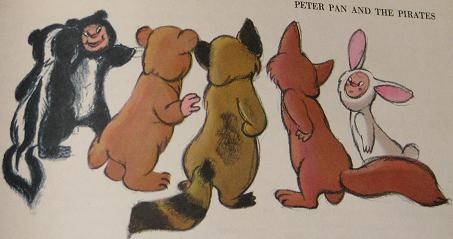
Next we have, "Peter Pan and the Pirates."  This story was in the sketch stage at Disney studios when this book came out. The film would eventually come out in 1953 (titled Peter Pan, of course).  The 13 illustrations have the overall feel that would eventually become the characters in the final film.
Lost Boys in "Peter Pan and the Pirates"

There is a picture that has Tinkerbell in it, but she is so tiny she just looks like a glowing dragonfly, but if you look at the front cover (top of the page)... Do you see that black haired, angry looking pixie?  There aren't any other pixies in this book!  It could be the original concept of Tink!

Disney was pretty close to their final character concepts at this stage.  Here is Captain Hook and Wendy:


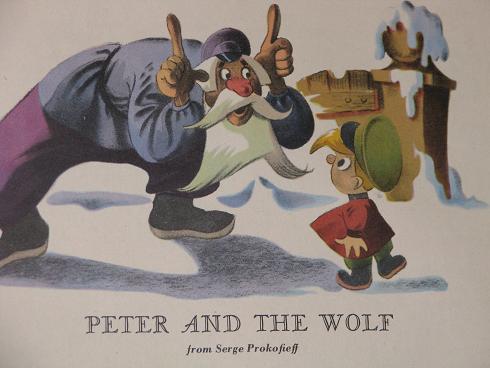
"Peter and the Wolf" comes next. Does that get the music started in your head?  I know it does for me.   The illustrations in this story aren't very close to the final film.  This is surprising since Make Mine Music (which features this short film and some others) would only come out two years later in 1946.  Maybe the stylized illustrations were a conscious choice by the Disney studio for this book, who knows?


I still like the illustrations, they are just... different.


Next comes "The Square World"  based on the story written by "The Walt Disney Studio."  The illustrations for this story are so unlike most Disney productions it is shocking, and they were working on making an animated film of it too.  Sadly, the film was never finished. There are six illustrations in this book.

Obviously, there are some World War II themes going on here! The basic plot is about a being named "The Mighty-Highty-Tighty" who wants everyone in the land to look like him... square. This very short story is stupendous and it is a great allegory for how wrong prejudice and racism are.  Here is one more picture (of racial harmony).
Are those Barbapapa? Nope, they're "The Square World" kids.


Last, but not least, comes "Happy Valley."  This one features Mickey, Donald, and Goofy!

I don't usually keep my cheese in the fruit bowl, but it looks nice.

If that picture is ringing a bell, it might be because this story would eventually be part of the 1947 film Fun and Fancy Free in a section called "Mickey and the Beanstalk."  BUT, this story is different. Mickey trades his cow to the Queen (Minnie Mouse) who gives him the magic beans that will do different things depending on how the moon is.  The beans are planted and the beanstalk carries the house high into the clouds.  Now, let's cut to the end of the story....during the shape shifting of the Giant into a big bunny rabbit.  After he does the rabbit, he makes himself into a super giant, but then while making himself smaller again, he gets too small (and younger).  He becomes so young he forgets the magic words to change himself into anything he wants.  Mickey and friends carry the giant back to their house via piggyback where they fall asleep.  By morning, the beanstalk has shrunk (because the moon was different).  Then they go see the queen and she pardons the giant and she gives him a job as her footman.  Oh, and they use what some consider an un-politically correct term by calling him the oxymoron "midget giant."

Mickey, Minnie, and the not-so-giant giant

And that, readers, is the end of this huge children's story collection.  Goodies galore!  I could have done a blog on each story!

If you look hard enough, you can find this book for a decent price... of course, if you want a pristine first edition, you'll most likely be paying much more.

Here are some links where you can find it on Amazon.com (I list what the original Amazon entry says that makes them different... please read the individual seller's write up for more detail):


Walt Disney's Surprise Package (listing says 1944, 1st edition)

Walt Disney's Surprise Package (listing says 1944, edition unknown)

Walt Disney's Surprise Package (listing says 1945, edition unknown)

Walt Disney's Surprise Package (listing says 1945, 3rd edition)

Walt Disney's Surprise Package (listing says 1946, 4th edition)

Walt Disney's Surprise Package (listing says 1948, edition unknown... it also says 76 pages which is much less then the edition I reviewed, a story or two may be missing... ALSO, one of the used copies under this link is listed as a 1944 first edition with a dust jacket)

Walt Disney's Surprise Package (listing says 1948, edition unknown)


Thank you for your time. Goodnight, sleep tight, and don't let the Zipperump-a-zoos bite!

Cheshire Cat in Walt Disney's Surprise Package

Coming Soon to a Blog Near You... This One, in Fact!

A little over one year, and several books ago, I blogged on here last. I shall return quite soon!

. . .


What? You want to know what is coming up? Well, I have A LOT of books that deserve more recognition. A LOT! Mercer Mayer? OF COURSE! Other authors? YES!

In the meantime, check out Mercer Mayer's latest (non-Little Critter) book called, Too Many Dinosaurs. It is scheduled to come out September 12, 2011! It looks like it is going to be a great book.

The books is going to be about a boy who wants a puppy, but ends up with a triceratops and one heck of a dinosaur dilema! I have seen a sketch of one of the pages, and it looks to be a lot of fun. Look at the cover below and try to tell me that those dinosaurs don't look too cool for words! It isn't a new Little Monster or Professor Wormbog book, but dinosaurs come close.


Speaking of Professor Wormbog... DING DING DING, Mercer Mayer's Professor Wormbog in Search for the Zipperump-a-Zoo is available again in hardcover from Fastpencil Premier for a VERY reasonable price (it is a part of their new Mercer Mayer Classic Collectibles/Little Monster Classic Collectibles line)! YAY! REJOICE! It is listed as being a little over 9 x 8 inches in size. So it won't be as huge as the awesome and amazing original release. It is also available in various eBook formats including Kindle and iBooks! BUT because of the size difference, I recommend getting the 1976 original Golden Books/Goldencraft oversized release still.


See you soon!